Tuesday, March 27, 2012

How Google Inspires Writers

Syd Field's classic Three Act Structure
I was listening to some Public Image Ltd. and writing a blog about Cameron Crowe when I decided to take a detour and read Syd Field's Screenplay: The Foundations of Screenwriting. Well, yes. You don't know this about me, but I love to read about the craft of screenwriting. Check out the graphic above -- Syd is known for his three-act structure. (You would do well to learn it.) I was inspired to read the text by an Internet search engine. See, Google has been reading my email and gathering information about me when I run searches. That's fine, you can snoop if you like. Writers are always snooping on people, listening to their conversations, stealing turns-of-phrases which sound not only clever to the ear, but look pleasant on the page. I had never read this seminal book by Field and I knew that I could always come back to the Crowe blog because well, I am in charge here. I try to be in charge, but there are times when I am swept by inspiration to new directions. Today's distraction was provided by the Internets premier search.

Snoops.
Google, or "Big Brother," had suggested this particular Syd Field text after spying on me as I wrote an email to a friend about a screenplay that I was writing. (Yes, I have multiple projects, I told you this. I'm not a put-my-eggs-all-in-one-basket writer.) My colleague had encouraged me to release the caged tiger -- as she referred to the project.  I smiled, I knew it was a large scale project that I could manage to rein in, if I had a  plan. I needed help. 

I didn't click on the advertisement because I wouldn't give Google the satisfaction. I merely headed over to the Cleveland Public Library website and ordered the text. It arrived days later and I was surprised by what I discovered on the opening pages of the first chapter, "What is a Screenplay?".

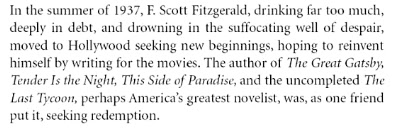
Page 17

Well, Mr. Field, you have my attention. Joseph Mankiewicz, and Fitzgerald in one paragraph!

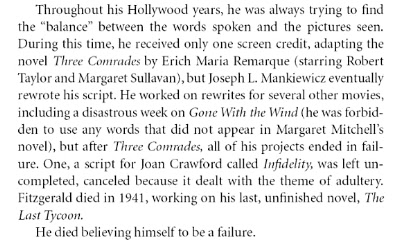
Page 17


Joan Crawford never starred in a Fitzgerald script -- Joseph Mankiewicz rewrote it.
My favorite author, F. Scott Fitzgerald was a bust as a screenwriter. Writing skill in one medium apparently doesn't translate to another one. While in Hollywood, Fitzgerald wrote to make money and according to Field, to seek redemption. He died without getting that redemption. Syd Field writes: "Talent is God's gift; either you've got it or not. But writing is a personal responsibility; either you do it or you don't." (Page 14) Well, Fitzgerald was talented and it was well-known that his lifestyle had ruined what was a brilliant career -- he had failed in that personal responsibility that Field's what was talking about in his text.

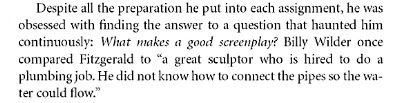
Page 16
Acquiring Field's book was a stroke of genius by Google. I doubt they knew about my affinity for Fitzgerald; but wait, they do provide the platform for this blog. Google brought together Fitzgerald and Wilder! Maybe snooping on me was a good thing. Here's something you don't know about me: I believe that the intersection of Billy Wilder, Joseph L. Mankiewicz and  F. Scott Fitzgerald was divinely orchestrated. 


Wednesday, February 29, 2012

Billy Wilder: Something Old, Something Cool


Screenwriter-director, Billy Wilder with Marilyn Monroe.

No one knows this, but I once checked out two library books and forgot to take them back. The books were screenplays for two films from 1950: "All About Eve", and "Sunset Boulevard". I remember walking along the stacks in the Fine Arts Department of the Cleveland Public Library to find them. Back in those days, there was only the main building and you had to take the stairs up to the Fine Arts Department. Michel Hazanavicius won the Oscar for Best Director, for the film, "The Artist". The Hollywood Reporter post-Oscar wrap-up included the following: "Hazanavicius thanked the late, multi-Oscar winner Billy Wilder three times, presumably for helping provide the inspiration for revisiting the days of silent cinema, even if Wilder never directed a silent film." Billy Wilder just happens to be another of those writers whose work I adore. When I read Maurice Zolotow's "Billy Wilder in Hollywood", I knew I had come across a kindred spirit. Wilder had worked as a reporter in Vienna--what could be more heavenly? He then moved to Germany where he worked for a larger newspaper until Adolph Hitler came to power in 1933. Soon, he arrived in Hollywood. He spoke no English. His partnership with writing partner Charles Brackett resulted in some of cinema's finest films--comedies like "Ninotchka"  starring Greta Garbo, and later, Wilder would write and direct one of my favorite dark films, "Lost Weekend". When my Academy Awards volume for 1950 arrived I was surprised to learn that Billy Wilder's "Sunset Boulevard" (#12 on the American Film Institute's Top 100 Films) had won Best Picture over Joseph Mankiewicz's, "All About Eve". Great writers pen classic scripts.
Writing partners, Charles Brackett (l) and Billy Wilder (r) with "Sunset Boulevard" star, Gloria Swanson.

One Saturday afternoon, I rode the St. Clair bus downtown to visit my library. I remember checking out many scripts and biographies. Carrying a bag of books was still cool at that point in my life. I don't remember returning the books. I do recall finding the two screenplays behind my bed one day. I had no idea how long they had been back there. I was shocked that I hadn't gotten a notice from the library. I didn't know what to do. I was afraid that they would make me pay for the books and I knew didn't have the money. One day I happened to be looking through my books when I discovered the scripts--years had passed. Of course, I spent the next week devouring the words and as luck, no fate would have it, it was spring and TCM was airing the classic Best Picture winners and nominees. I watched both films thinking how well Wilder's work had stood up over time. Later in the week, "Lost Weekend", and "Double Indemnity" both aired. 

I should mention that Wilder's cache grew exponentially when journalist-turned-screenwriter and director, Cameron Crowe spent a year talking to the director. The resulting "Conversations with Wilder" is a classic. Two of my writing heroes (reporters-turned-screenwriters) together in one volume. Crowe, another kindred spirit got it--Wilder was the man. After last Sunday's Academy Awards, I think we all know that everything old is cool again, at least where Billy Wilder is concerned.

One of my favorite Wilder quotes is: "I was not a guy writing deep-dish revelations. If people see a picture of mine and then sit down and talk about it for 15 minutes, that is a very fine reward, I think." 

Monday, February 27, 2012

What Every Writer Wants

Mont Blanc Skeleton A+380 
You don't know me. I love writing instruments. I'm a writer and what I want is to sign my first contract with a fine writing instrument like the one above. In fact, any Mont Blanc will do. A writer who doesn't love an instrument like the ones manufactured by Mont Blanc is one who has never tried one! As you may or may not know, Mont Blanc is the highest mountain in the Alps, and it is also the name of the world's finest pen. However, the Namiki Pilot is also a handsome instrument and I'd settle for the one in the photo below. In fact, the Namiki Pilot makes a fine gift when the giver couples it with a package of purple ink cartridges.

The Namiki Pilot, an instrument that I adore.
Remember, I'm old school. I love all the old writers and this isn't a knock against today's writers; I hope to be one of them. The idea of being a writer back when you knocked out your manuscript on a manual typewriter still appeals to me. See, I started writing on a manual machine. I used to go to the old Cleveland Typewriter on Lee Road with my father. I loved walking through the store looking for just the right machine to join my mind and heart and soul with in order to produce the next great American novel. By the way, I am still working on that novel.

Cleveland Typewriter on Lee Road in Cleveland Heights, Ohio.
Even though I have not signed my first contract, or purchased my first fine writing instrument, I am hard at work on creating product. In addition to the play, "I Came Here As Me", I have a novel, "The Warhol Moment", and two memoirs that I am trying to complete. "Judgment In Goshen: Taxonomy of An Ordinary Murder", is a crime novel about my time on a mass murder jury. "None of My Idols Were Worth Worshipping", is about my time as a music journalist. I have plenty of work to keep me busy.

In addition to all of these projects, I am working to position myself as an expert on 1970s music. I plan on lecturing as a musicologist, which is something that I have done in the past. This web presence is my attempt to brand the writer, Charlotte Morgan.

Thanks for listening. If you are a writer, please keep writing. If you want to be a writer, find yourself a course at a nearby college or university. In my hometown, we have some wonderful writers and poets eager to share their craft with students. Or find yourself a workshop if you have a manuscript. Whether you use a pen, pencil, typewriter or computer, just keep writing.


Wednesday, February 22, 2012

The King of The Deal, Super Agent Swifty Lazar

Chuck Pick at Spago's with Irving "Swifty" Lazar, super agent.
The 84th Annual Academy Awards air Sunday, February 26th on ABC. I am a writer, so when Oscar time arrives, I find myself filled with anticipation. I actually find that the build-up to the Academy Awards is maddening--I want to watch, I don't want to watch.

I want to be in that audience. I can't wait for that category--Best Original Screenplay--to be announced. Of course I want to win. In order to get my original screenplay produced, I need an agent--a super-agent. When I was a kid, besides reading books, I spent the remainder of my time in a movie theater. I had figured out that writers wrote movies. And writers need agents to represent their work. Irving "Swifty" Lazar was featured in one of my Academy Award books. Decades later I would read Michael Korda's great piece, "The King of The Deal", which appeared in the New Yorker in March of 1993. More recently, Lazar's appearance on screen in "Frost/Nixon" reminded me what a player he was--Swifty represented ex-President Richard M. Nixon. Korda is best remembered as an editor-in-Chief at Simon & Schuster.

Korda paints a picture of an agent, a short, perhaps foppish man with gigantic glasses who wielded power whether he was on the east or west coast. Korda writes, "At “21,” I had only to mention Lazar’s name to be treated like royalty. I was swept to a red-checked table downstairs, opposite the bar, and given a bowl of celery and olives on ice and a basket of rolls." Korda in his reportage, reveals the truth about this super-agent--Lazar never considered himself an agent at all. He saw himself as a deal-maker. Hollywood stars had an agent and Swifty Lazar to make deals for them. With big name authors, Lazar would offer them up to rival publishing houses whether he actually represented the writer or not. The story about Lazar offering up Truman Capote without his permission is a classic:

“Truman Capote,” Lazar said, way back at the beginning of our relationship. “Wanna do a deal with him?” At the time, Capote was high on the best-seller lists, and was one of the bright stars at Random House, while I was an unknown junior editor at a house not then famous for fiction. It seemed to me unlikely that Capote would want to leave Random House, or that Random House would let him go, and I said so. “I can see you don’t have the guts for this kind of thing, sonny,” Lazar sniffed—he always called me “sonny” when he was pissed off—and he hung up, no doubt to offer Capote elsewhere. (Capote was still a Random House author when he died.)

But back to the Hollywood angle. As a child, my parents indulged my love of Hollywood by gifting me a subscription to the Academy Award club. Each month a new volume arrived in an envelope and inside was a look at the awards by year. There were in-depth articles on the Best Picture winner, the Best Actress winner, etc. I was of course struck with the fact that there was a category for writers.  It was at this point in my life that I began to learn the names of screenwriters.

I learned about the Writer's Guild of America. I discovered that there was one on each coast, but it was the one on the west coast which interested me the most. There was a list printed with some of the best film scripts ever written. Lazar not only represented some of the top writers, he also made deals for screenwriters, directors, actors, and  producers whose work appeared on that list. I wanted my work on a list like that and I certainly wanted Lazar for an agent. However, his real claim to fame came Academy Award night time, when the A-list stars -- many of them his clients -- attended his Oscar party held at Wolfgang Puck's Spago's restaurant. 

When Lazar died, Hollywood lost not only an iconic deal maker, it lost one of its most glamorous parties. I lost an opportunity to be represented by one of the great deal-makers. I love the Oscars.


The stars gather at Spago's. (At left, Lazar and his trademark glasses.)


Friday, February 17, 2012

Everything Old Is Cool Again

Screenwriter and director, Joseph L. Mankiewicz
As a writer, I am always thinking. I am thinking about what to write next. I am pondering how to write narratives that I think will sell. And I am always thinking about my audience. When I was a kid, writing was for me and me alone. I had my writing idols, they inspired my work. I was a kid remember, so the work was so poorly written that there was never any chance of it getting published. But, lo and behold, by the time I was eight years old, I had my first newspaper job. I worked as the editor of the Stephen E. Howe Elementary School newspaper. It was just a mimeographed sheet, but it gave me the experience in running a publication. And sure, I was the only staff member, but that was because none of my peers saw the advantage of knowing what you wanted to do in life. They didn't know what they wanted to be; while I knew that I wanted to be a writer. I learned over the years that my friends were never truly close to me because they didn't know who they were and my vision for my life seemed to offend them. I was always studying some writer or director. I had to find someone to inspire me -- and you will find that I talk about inspiration a lot because I can't just get up and write without being moved to do so. I find that when I read about a writer, or watch a film about writing, it causes me to go to my keyboard.

The photo above is of a writer I have admired most of my life. Joseph Mankiewicz has penned several of my favorite screenplays. I love writers and I don't care what they write and I love what Mankiewicz wrote. "The Barefoot Countessa" and "Letter to Three Wives" were two of my favorite screenplays written by the former Hollywood dialoguist. His most famous screenplay of course, was "Cleopatra", starring Liz Taylor. He's a hell of a director as well. "All About Eve" is one of the American Film Institute's Top 100 Films...in 100 Years. Joe's witty dialogue is what attracted me and in this Bette Davis tour de force, the screenwriter is at his best. And don't forget, the screenplay was based on the 1946 short story by Mary Orr called "The Wisdom of Eve". Writers write words and cause more words to be written.

Oh, Madonna, this is straight out of Mankiewicz's "Cleopatra"
 I've lived long enough to watch these old school Hollywood screenwriters become popular again. Recently, Madonna's Superbowl performance garnered rave reviews for its grandeur, but fans didn't know that she had used the grand entrance to Rome scene straight from Mankiewicz' s "Cleopatra" pages. She couldn't use the black slaves because it would have been in poor taste. But this is not about Madonna, it is about how everything old is cool again and we have to remember that those dramatic scenes are written first by a writer leaning over a typewriter with a pipe in his mouth and a shot of whiskey in a nearby glass. Thank you Mr. Mankiewicz.

Saturday, February 11, 2012

Every Beginning Has A Start

Author F. Scott Fitzgerald
My start began with a novel by F. Scott Fitzgerald. I was only three years old. Or maybe I started reading it by the time I was five years old. I think it was Tender Is The Night or was it This Side of Paradise? The first book was a gift from my father who had purchased it from the Salvation Army Goodwill store, which was located across from our house.

I remember being fascinated by the words on the page. A colleague at work said that he couldn't remember reading at such an early age, let alone reading Fitzgerald. I never said that I understood the big words, however, I said that the book transformed my life. I knew that I wanted to be a writer. My life had purpose.

I began a quest to find out as much as I could about Mr. Fitzgerald. I grew old enough to venture to the Glenville branch of the Cleveland Public Library on Parkwood Drive, and there I would browse the stacks to find the Fitzgerald books. My hands ran across the spines of books by men and women that I had never read. I would sit at the large wooden table and run my fingers across the words on the pages. This is what I wanted to do -- make words magically appear upon the page of a book.

Soon, I was confronted with a big question: How do I become a writer? I decided to read more about Fitzgerald. I read all of the novels and the short story collections so that I could become familiar with his characters and his style. I watched the film renditions of his books and found them always missing something. I became a student of the Roaring Twenties, and dreamed of lecturing on the authors of that period in a collegiate setting. However, I still didn't know how to become an author.

Interior of the Glenville Library
In the months and weeks to come, I hope to share more about my journey to become an author. At least now, you know something about my start--it began with F. Scott Fitzgerald.

Friday, February 10, 2012

A Writer Will Learn To Write

Kate Hepburn: Reading her biography was heavenly.
Someone asked me where I went to school and I had to tell them that there was no one place. I learned my craft at the library like many writers. We have a fine library system in Northeast Ohio. I spent part of my youth in the Fine Arts Department of my city's main library. I tried to read as many Hollywood biographies as possible and I continue this practice to this day. And sure, I went to college, however, I discovered that craft is not easily taught when you don't have writing faculty members. I don't mean scholarly writers, I mean, working writers who teach the craft of fiction and non-fiction writing. There were several British Literature professors at my school, but I only had one real writer-teacher, and that was the late Sheila Schwartz. She was beloved by her students.

Sheila talked to you like a writer. She took you to task for your sloppy work, she complimented you when your work deserved it. I took advantage of my time with her to develop my skills as a fiction writer--I had been told not to go there. But I knew I was more than a memoir writer.

But I go back to reading biographies and what it did for me as a writer. I received inspiration from the stories of famous people. You never realize what a person goes through to ascend to great heights in this life. Biographies not only celebrate the life of the subject, but also that of the person who spent those years researching that person. I cannot imagine the hard work that is involved in writing the biography of a Hollywood icon like say, Katherine Hepburn.

If I were to be given a chance to write a biography, it would be difficult to think of a personality that I would want to spend years researching. Therefore, I'd probably rather research some like writer-director, JJ Abrams (Lost, Alcatraz, Cloverfield, Alias, etc.). He is almost like an old-school writer-director--someone with a definite non-Hollywood point-of-view. I am excited by this kind of against-the-grain thinking. Abrams thinks like a writer.  A writer will learn to write--his life is his classroom.