Showing posts with label rock journalism. Show all posts

Friday, March 13, 2020

Tell Me That I'm Dreaming: Don Fagenson of Was (Not Was)

Image result for don fagenson
From right to left: David Weiss and Don Fagenson of Was (Not Was)
Photo courtesy: David Corio/Redferns/Getty Images 
"To me, (Don Was) is very much like working with Jimmy Miller, who's a producer but also a musician. To the Stones, it's a real extra plus to have a guy that knows how things are played, what's done.” – Keith Richards.


            I was sitting on the floor in my room eating my second box of Cracker Jacks and guzzling a can of Barq’s Root Beer when my new friend Don Fagenson, leader of the neo-funk and rock group Was (Not Was) called.  He was at singer-songwriter Carly Simon’s house in Martha’s Vineyard.  He was excited and I was honored that he thought enough of me to call.  Seems Don was there to work with Carly on her latest album.  The album would be called SPOILED GIRL.  He said they (Carly and Epic Records) called the “big guns” in for the project.  Luther Vandross, the background singer and vocal contractor, was coming by to work on the project.  This was Don’s big break and the bass player had to tell someone.
Musicians loved to talk to journalists.  The relationship between a musician and a writer is like that of a rock star and his priests.  We writers worship musicians, making idols out of them based on their talent.  And along the way musicians have learned that’s how their legacy is built—on the typewriters of icon worshiping journalists who want to be the first to discover a legend in the making. 
After several years in the business—entertaining singers and musicians over dinner after shows—I had earned an underground reputation.  I was considered funny and most importantly, I was considered psychic because I could tell the future.  I wanted to believe he called me because it was what I told him would happen—he would become one of the industry’s most important producers.  And he would produce many of his favorite artists.  This was just the beginning.
            I became acquainted with Don Fagenson right after the first Was (Not Was) album debuted in 1981.  I was still a music journalist in the early 80s.  I had my national gig with Rock and Soul Songs, but the industry had changed with the death of the vinyl album pending and the emergence of the new format for music—the compact disc—my days at Cleveland Scene Magazine were numbered.  No one wanted a writer who was so closely associated with dance music and self-contained R&B groups. The post-soul movement saw Hip Hop as its flagship genre, while arena rock, new wave and punk dominated the charts and radio airwaves.  And as a black writer I wasn’t allowed to write about those recording artists.  But that didn’t stop me from looking for the next big act.
Was (Not Was), the up-and-coming funk group out of Detroit, Michigan held a lot of promise.  I found myself up on Coventry at Record Revolution looking for their hard to find Euro-dance hit “Wheel Me Out” single and over at the drug store looking through Rolling Stone, Billboard, CREEM, Hit Parader, Circus, SPIN, GROOVES, Melody Maker and the Village Voice to find information about the band.  
            I read that Fagenson and his partner flutist David Weiss loved funk, R&B and rock music.  They were after all, Detroit white boys who grew up worshiping Iggy Pop, the Stooges, the MC5s and Parliament-Funkadelic.  One of my friends, Jeannette McGruder (Satori Shakoor) now a sought-after background vocalist, worked on the debut self-titled album which was released on the independent Ze label.  Jeannette was a hometown girl who left Luther Vandross’ group in New York to sing with P-Funk.  With the demise of George Clinton’s Motor City Empire, producers like Fagenson were scrambling to pick up unemployed funk musicians and vocalists. Landing some of Clinton’s talent was an attempt to mimic his chart success by laying funk on your tracks.  Fagenson’s formula for success was a sure one—funk, rock and R&B vocals over his satirical lyrics.  It worked.  Was (Not Was) were quietly the next big thing.  I wanted to find about more about this new music.
            In March of 1981, I ventured up to Detroit to see George Clinton’s emancipated (they left the organization to strike out on their own) Brides of Funkenstein perform their new wave set at Bookie’s 870 Club on West McNichols. We heard that Fagenson, who was among the musicians to play at Detroit’s first punk nightclub, might be at the show.  We knew he had read the piece on the girls in the Detroit Free Press publicizing the March 18th gig. 
There was a mixed crowd in the packed house—“It’s all kinds of freaks and geepies out there.  Some funk, punk, fags and hags is out there,” a Chicago funk groupie named Suzie Creamcheese said.  The Electrifying Mojo of Detroit’s WGPR 107.5 FM hyped up the show by playing a lot of Was (Not Was) and Brides music.  We looked for Fagenson, but no one spotted him.  I didn’t know what he looked like anyway.  I leaned insecurely against the wall in the corner of the filthy dressing room while the band held court with friends, fans and drug dealers.  The dingy walls were covered with expletive filled punk mantras written in black permanent marker.  This was definitely not Cleveland’s Agora Ballroom, an iconic venue where legends were birthed.  
            I met a guy from CREEM Magazine.  Don’s group appeared on the cover in 1981 with their name in small print on the hem of Pat Benatar’s skirt.  The writer leaning over me was the infamous Mark J. Norton.  Someone I didn’t know introduced him to me.  I was that black girl from Scene Magazine who handled publicity for the Brides.  Mark kissed me on the cheek, and I noted that he smelled like sour gin and weed.  But it was a friendly kiss.  He dragged me deeper into the dressing room because, “We music journalists need to be up close to record what was going on.”  After dropping out of the University of Michigan, Fagenson produced Mark’s band as one of his first projects. I knew he could point Don out to me.  But I felt safer staying in one place until the show started.
            I didn’t want to walk around.  We were scared (the Brides and I) that George was going to come and put a damper on the show by trying to take over.  See, George and the legendary Sly Stone were supposed to be at United Sound Studio working on the next Brides album but instead they were on an alleged prolonged cocaine freebasing binge.  The leader of Parliament-Funkadelic was likely to be found anywhere in Detroit where there was music, money, women and a spotlight.  He knew drugs weren’t far behind.  Neither George nor Sly appeared before the set began. 
             I went downstairs to watch.  The Brides’ revamped show—I suggested the girls drop some of the funk and perform songs by up and coming new artists like Grace Jones, Carolyn Maas and Lene Lovich—was electrifying.  From the reaction of the audience, they agreed.  By the finale of the show, George Clinton had climbed up on stage doing his Dr. Funkenstein stitch and he proceeded to call the girls “his bitches”.  He kept saying how proud he was of “his bitches”.  Oddly enough, each time he called them “bitches” the crowd got more excited. 
            I cried quietly as I watched him humiliate the girls.  In the excitement, someone pushed me off my stool and I almost landed face first onto the sticky floor.  I was okay. In the limo ride back to Henry Mayer’s house—he was the Brides’ manager and George Clinton’s supposed drug dealer—no one said anything.  They were all breathing heavy. I took out my toy compass to play with while they smoked a joint.  We all started laughing.  “George f**cks up everything don’t he,” Jeannette McGruder said.
            We never saw Fagenson at the show.  I eventually got his number from Ze Records head, Michael Zilkha.  His wife Cristina was a socialite and mutant disco singer whose deadpan vocals and great tracks courtesy of Don and Was (Not Was) and August Darnell of Kid Creole and the Coconuts fame, were hot.  I originally called Zilkha to get an interview with his wife.  Her single, “Things Fall Apart” on the Ze Christmas album featured lyrics about a wealthy socialite who gets beat up for the holidays.  I read about her on the pages of Andy Warhol’s trend-setting Interview Magazine.  If Glenn O’Brien wrote about it, I knew I should.
            But Zilkha throws me off when he reveals that Fagenson is frantically looking for the Brides because Was (Not Was) is going on tour.  So, I call Fagenson at the Sound Suite Recording Studios on McNichols where he was working.  I get his production coordinator, Garzelle McMurray.  She puts Don on the phone, and we hit it off immediately.  I tell him how much I love his work and he laughs.  He asks me about myself and what I do.  I explain my background and he asks me if I’ve written anything outside of music journalism.  Confident that he likes me, I then reveal I’d just completed a treatment for a film I wanted to do, called “Afro Beach Party”.  I tell him that I saw that the movie soundtrack would be bigger than the film in the future and that he’ll be doing soundtracks in the near future.  
            Now interested, he talks with me on a regular basis.  I hook up Dawn Silva and Lynn Mabry of the Brides of Funkenstein, with Don to tour as background vocalists.  They hit the road together in 1982 and take the music world by a quiet storm.  They are the darlings of the new wave and funk set.  They grace the pages of all the right magazines and Village Voice writer, Robert Christgau hails the Brides as the best girl group since Labelle.  I call Steve Mass and help book the girls a gig in New York at Soho’s legendary Mudd Club, home to everyone from Blondie, Klaus Nomi, Lydia Lunch, Talking Heads and the Ramones.  Tina Weymouth and Chris Frantz of the Heads are at the show along with Christgau and legendary keyboardist, Bernie Worrell of Parliament-Funkadelic.  The hype after the show causes promoters to book larger venues for Was (Not Was).
            In one of our next conversations, I remind Don that he will be the industry’s next big producer.  And he returns the compliment by inviting me up to Detroit to visit while he produces Helen Terry.  Helen earned a name singing with Boy George and Culture Club on hits like “Church of the Poison Mind” and “Karma Chameleon”.  So naturally, I want to hang out and meet her.  Fagenson is also working on the “Electric Dreams” movie soundtrack that would feature Donna Summer producer, Giorgio Moroder, Culture Club and Human League front man, Phil Oakley.  This was an important job for Fagenson.  The soundtrack would eventually make more money than the film.  The Helen Terry album, BLUE NOTES would be released on Virgin Records.  Don uses most of the Was (Not Was) crew for the project.
            My friend, Raymond Jones who was making a name for himself as a sideman playing for everyone from Talking Heads to Nona Hendryx is on keyboards for the album.  I hook him up through Garzelle.  I arrive at my hotel in Southfield and call up Garzelle to find out when we can come to the studio.  Of course, Don is busy laying down tracks and can’t be disturbed.  So Garzelle suggests we go eat at a place called Chique-A-Freak, an African restaurant near the 20 Grand Lounge on West Warren.
            I enter the dingy restaurant remembering Garzelle’s claim that, “The raunchier the place, the better the food”.  I’ve heard this before, and I know it to be a lie.  Ray is there, Garzelle, Helen Terry, Sweet Pea Atkinson, Was (Not Was) lead vocalist, David McMurray, the band’s horn player, my friend Jeff Wright and me.  Frightened by the menu, we order something safe and familiar with chicken and greens.  I order an iced tea and Helen begins to tell stories about Boy George.
            She’s delightfully bawdy and loud as she tells us all George’s love life business including his attempt to go to bed with Luther Vandross.  Her plump cheeks turn redder with every probable lie.  Apparently, Luther doesn’t like big boys and George was rather chubby underneath all those androgynous clothes he wore.  She claims Luther regularly cruises Central Park in his limousine to pick up young boys.  But because he’s so big, he doesn’t get many takers.  Raymond takes the opportunity to tell the story of how Luther wasn’t asked to be a part of the disco group Chic because he didn’t fit their ‘look’.  It was so scandalous that you had to laugh. 
            Not to be left out, Sweet Pea tells us about Dawn and Lynn out on the road with Was (Not Was) and how they supposedly slept with all the band members except him.  He was talking so fast that I couldn’t keep up with his profanity laced tirade.  We sat in that restaurant for hours laughing and talking.  But one by one people excused themselves from the table and either went to the bathroom or outside.  We all had gas and diarrhea from the spicy food and so I stayed in my hotel room for the rest of the night.  I never made it to the studio.  I wasn’t worried, I knew we would meet, I saw our meeting like I saw his future success. 
            Just like I predicted, time ran out on Scene Magazine.  I was called back to cover major events like the Jacksons’ Victory Tour in 1984.  But it was over for funk, dance music and R&B.  So, I decided to put out my own magazine.  I began to publish an art deco styled underground fanzine featuring old Hollywood portraits on the cover and sarcastic headlines.  I named the rag Poor Elite Magazine. 
I used my industry contacts to build a customer database.  I realized people loved my sense of humor and take on events in the business.  I had readers all over the world as witnessed by the international letters that would arrive irregularly at my house.  People loved the profiles and found the prophetic utterances about the music and film world odd, but interesting.  Don was a regular reader of the magazine because he was on the mailing list.  Garzelle would read it before Don got a chance.  She invited me back up to Detroit to consult on publicity for the Sound Suite Studios where Michael Powell was working to finish the new Anita Baker album using a brand new Solid State Logic board (SSL).  This new mixing board was supposed to be on the cutting edge of new technology and would revolutionize the industry.  The studio paid for the weekend and I still didn’t catch up with Don. 
            Seems Don talked a lot about me and was impressed with my intellect or so she said.  We would talk over the years and I kept reminding him one day he would be recognized as a great producer, calling me from Carly Simon’s house was fitting.  But I still had never laid eyes on Don.  He worked on Carly’s album and it was hailed by critics as some of her worst work.  But I knew this was a mere setback. I was surprised that a major label would put an artist like Carly Simon known for her powerful lyrics, with an odd fellow like Don Fagenson considering his early records featured lyrics like, “Woodworks squeaks and out come the freaks.” 
Image result for was (not was)
                      Don Fagenson. Photo courtesy: Ron Baker (Creative Commons License)
            Don was more at home on his next big project.  He produced and played on the B52s COSMIC THING album.  The B52s, known as a great party band from Athens, Georgia shared Fagenson’s affinity for quirky lyrics.  Their collaboration would mark the band’s greatest commercial success with the single, “Love Shack” reaching as high as #3 on Billboard Magazine Single’s Chart.  Don would go on to produce the next couple of B52s albums but was never able to capture the success of COSMIC THING.  No matter, the singles, “Roam” and “Love Shack” kept the band touring for years.
            In the music industry, success means you get the high-profile jobs and the choice of passion projects.  By 1989, Don Fagenson had hit the big time.  That year, his work on Bonnie Raitt’s NICK OF TIME album earned the singer-songwriter a Grammy Award for Album of the Year.  Raitt’s career was jump-started and she’d gone from being a journeyman blues guitarist and singer to becoming one of the industry’s most respected musicians.  The bluesy pop sound they created resulted in classic songs like “Nick of Time” which is still being played on the radio today.  Their collaboration ended when Raitt decided she wanted to try different producers. 
Five years later he would win a Grammy for Producer of the Year, the pinnacle for any recording artist.  Early on, he was successful not only because he was talented, but also, he was easy to work with.  Don could enlist everyone from Iggy Pop, Mel Torme, Frank Sinatra, Leonard Cohen, actress Kim Basinger and Ozzy Osbourne to appear on his recordings.  By the way, he meets Basinger while producing Bob Dylan.  Kim in fact replaces the vocals of a newcomer named Madonna.  Fagenson learns Madonna felt slighted by the rejection, but he wasn’t impressed with her as a vocalist. A decade later when the band’s European label wants to do a remix of the track featuring the original vocals done by Madonna and Ozzy, she refuses, and actress Kim Basinger enters.
How a band as surreal as this could ever score a hit was beyond me.  Fagenson and Weiss prided themselves on putting whatever came into their consciousness into the music.  Consequently, the band was known for being more an underground act; however, somewhere along the way, they went mainstream with a hit record called, “Walk the Dinosaur”.  The single from their 1988 WHAT UP, DOG  album spawned a clever little music video that featured vocalist, Sweet Pea Atkins singing typical Was (Not Was) lyrics:  “Open the door, get on the floor, everybody kill the dinosaur”.  Unfortunately, the video made MTV heavy rotation and landed the band on a tour with the year’s hot acts.  David Weiss however, was not happy with his group’s commercial direction.  Don’s commercialized sensibilities dominated the creative process causing some critics to label subsequent recordings by the band as Don Fagenson solo projects.  But the band would stay together a few more years before breaking up.
            Before they would break up, they would reach their collective commercial peak as a band.  When the Club MTV Tour rolled into the Richfield Coliseum in 1989, Was (Not Was) had another hit, “Spy in The House of Love”, and it afforded me a chance to finally meet Fagenson and see the band perform.  On the bill was rapper, Tone-Loc, Was (Not Was), the Information Society, Paula Abdul and Milli Vanilli.  MTV’s Downtown Julie Brown was the host of the show.
            I finally got to put my arms around my pal.  He wasn’t tall as I expected but had an unexpected beautiful shank of curly dark brown hair.  He hid his eyes at first behind those trademark sunglasses, but he quickly removed them as if he knew I really wanted to see if he was all I predicted.  Looking in those dark brown eyes, I understood how he connected with people—he was quietly charismatic and exuded an air of confidence.  You knew he could do what he promised.  He was a hard working musician who could be trusted with your artistic vision. 
Yes, I was proud that he had a hit record and was gaining respect as a producer.  I bought everything he worked on and kept the vinyl records bearing his name and sound in a separate stack.  Don posed with me backstage holding a copy of my Poor Elite Magazine.  Everyone in the band knew about it because Garzelle made it her duty to circulate it.  Her husband, David McMurray with his saxophone slung around his neck, pulled me next to him so he could pose with the magazine as well.   Even Sweet Pea wanted to pose.  But the band had to get ready for their set, so I went out front to watch some of the show. 
I couldn’t wait to see Milli Vanilli.  Most music journalists hated them because they were blatant music automatons created by producer Frank Farian who was best known for creating the disco group, Boney M.  The gorgeous German duo of Rob Pilatus and Fab Morvan with their long braids and lean muscular bodies were usually outfitted in form-fitting biker shorts.  In other words, they were shamelessly styled for the growing female MTV viewership.  This demographic influenced record companies and changed the industry.
            The sellout audience consisted of by and large those young girls and the duo gave them their money’s worth.  Downtown Julie Brown stood like the queen mother in the wings watching.  I had made my way backstage because I couldn’t enjoy the show out front—too much screaming.  I watched Julie out of the corner of my eye.  She looked bored by Milli Vanilli’s set—I guess because she’d seen it so many times.  But other people backstage seemed impressed with how the duo managed to be so athletic and still have the wind to sing.  Well, as it turns out they weren’t singing.  They did their now patented leaps in the air and landed without opening their mouths.  Seems they were out of breath and couldn’t keep up with their DAT (digital audio tape) track.  I looked at my friend Jeff and he looked at me.  “Hey they weren’t singing”, he said.  He said it loud enough for people to hear.  I looked over at Julie and she looked at us with one eyebrow lifted up inquisitively.  The duo would be exposed for not singing to a tape but for not singing at all. 
            Meanwhile during the Was (Not Was) set, I felt embarrassed for Don and the boys.  They played their heart out and only received a warm reception from the crowd.  The audience was there to see Milli Vanilli, Paula Abdul and Tone-Loc.  They didn’t know how to respond to a real band, and I don’t blame them.  It was hard to peg the group’s sound.  They played jazz, funk, fusion, R&B and rock.  You couldn’t put a label on them.  Record buyers were already jaded.  When the British duo known as the Buggles sang, “video killed the radio star”, they didn’t know how true this would become.  In the early days of music video, it was all about the look and less about the music.  If your video looked good, then the song was deemed good and got radio airplay.  This meant it sold records which translated into touring dollars.  Nothing has changed today. 
            When Was (Not Was) dropped their “Tell Me That I’m Dreaming” single in the early 80s, there were still intellectual music buyers who were enchanted with the song’s funky dance grooves and sampled vocals from President Reagan’s State of The Union speech.  They made a statement with their music and you could dance to it.  Don (Was) Fagenson was a hip, cool musician who other musicians and singers wanted to work with.  But the band’s ability to sell records was questionable at best and they would pay for it by having to switch labels time and time again. 
When Don proved he could make commercial music when Was (Not Was) hit the Top Ten on Billboard’s Dance Chart with a remake of the Temptations “Papa Was A Rolling Stone”, I was surprised and pleased.  However, he earned his mantle in the business through production.  He proved that he could revitalize the career of any mainstream rock and pop act.  His reputation was such that everyone from Elton John, Bob Seeger, Paula Abdul, the Eagles’ Glenn Frey, Jackson Browne and the Rolling Stones hired him.  He reached the pinnacle of success in 1995 when he won Producer of the Year for his work on the Stones’ VODOO LOUNGE album.  His old school production philosophy was credited for the Stones comeback.  He resurrected the Stones’ sound and was rewarded with the Grammy for Best Rock Album.  When I read about Fagenson in France recording with Mick Jagger and Keith Richards, all I could do was smile.  And today he still produces the Stones—the World’s Greatest Rock and Roll Band. 
            But I remember reading that for Fagenson, producing his idol Bob Dylan’s UNDER A BLOOD RED SKY was also a major coup for his career.  In January of 1990 he found himself at the Oceanway Studios in Hollywood recording with Dylan on piano, Jimmie Vaughn on guitar, and Kenny Aronoff on drums.  Dylan would record with everyone from David Crosby to Guns N’ Roses guitarist Slash, to pianists Bruce Hornsby and Elton John on the project.  Don would of course bring in Was (Not Was) members, David Weiss, David McMurray, and Harry Bowen to work on the legendary singer-songwriter’s tracks. 
            Now a successful producer based in Los Angeles, it was no surprise when he was spotted at the Academy Awards luncheon one year.  Don had embarked on a career in writing music for movie soundtracks. He’s worked on such films as “Hope Floats”, Tin Cup”, “The Rainmaker” and even lent his voice to “The Country Bears”.   After September 11, there was a special put on by big-name music and movie stars.  Of course, Fagenson was in the band performing behind such music giants as David Bowie, and Stevie Wonder to just name a few.  He was an elder statesman by this point in his career; and proved it by serving as the Keynote Speaker at a recent Motor City Music Conference. 

Image result for Don_Was
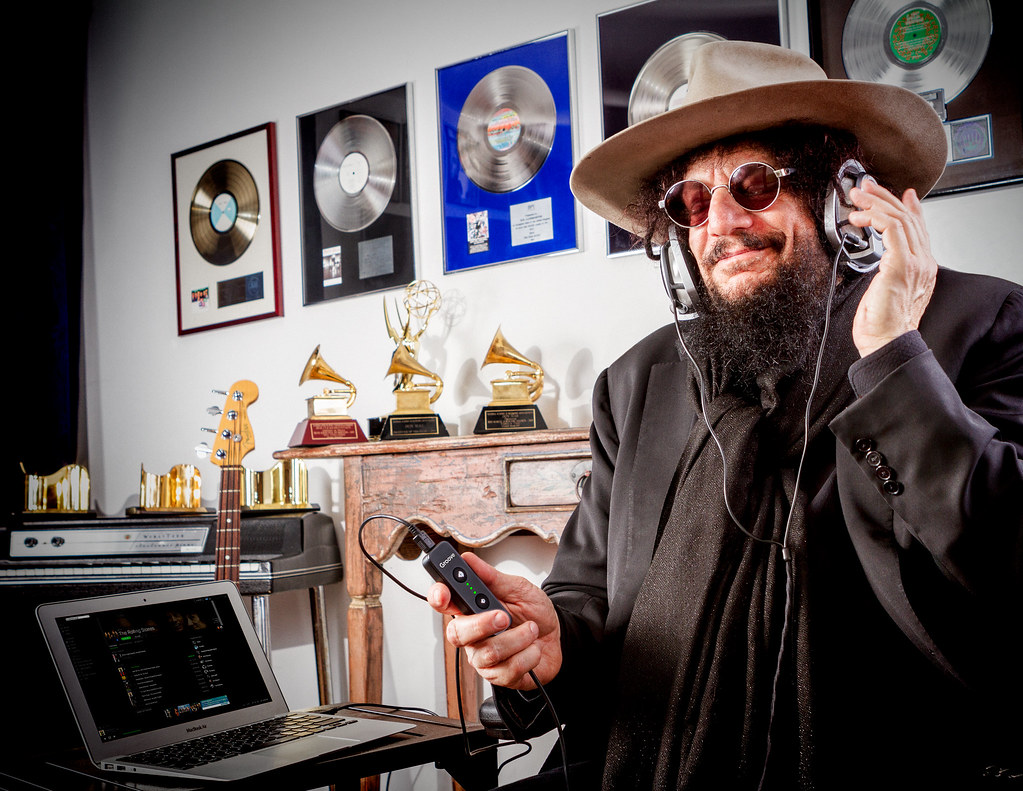
Don Fagenson. Photo courtesy: David Podosek (Flickr.com) 
            Here he was the legitimate favorite son of Detroit.  His subsequent partnership with Ford to work on a Lincoln Mercury ad was questioned by some critics who felt he was selling out again.  Fagenson wasn’t a sellout, he was versatile.  People loved what he could do in the studio—he could recapture an artist’s lost musical aesthetic and identity.  This was especially true for his work with the Stones, Bonnie Raitt and even Elton John.  Then he could easily switch gears and write music for Richard Dreyfuss’ “The Education of Max Bixford” series, direct documentaries like “I Just Wasn’t Made For These Time” a look at the life of Beach Boys’ leader Brian Wilson; as well as produce music for major ad campaigns.  Fagenson maintained his integrity throughout his career.  I mean, who else in the business could produce Elton John, Willie Nelson, the Stones, Bob Dylan and release music like that found on the surrealistic lyrical albums of Was (Not Was)? 
            I’ve followed Don’s career over the years and have been impressed with his every move.  He’s accomplished all that I foresaw and more . 

About the author

Charlotte Morgan is a writer who was born and raised in Cleveland, Ohio where she has been fortunate to teach First-Year English at her Alma mater Cleveland State University. She has led Non-Fiction workshops around town in the hopes of helping others find their voice. As a writer, from time to time, her work investigates the black experience in the urban pastoral in the hopes of understanding not only why her ancestors were brought to the States but what was their destiny and purpose here. Her aim is to rob the graveyard of her insights, and ideas so that future generations have access. As a longtime journalist, her use of literary reportage has been influenced by the works of New Journalism writers like Tom Wolfe, Truman Capote, Joan Didion, Hunter S. Thompson and Cameron Crowe.  She seeks to skillfully capture images and dialogue which enlivens her prose.  

Excerpt from None of My Idols Were Worth Worship. Copyright 2020© MorganWorks.  
@morganwriter (Twitter and Instagram) 


Sunday, March 8, 2020

Black and Almost Famous

Cover courtesy of Cleveland Public Library Digital Archives. 


CHAPTER XV: Dream Merchant Number 5
(from None of My Idols Were Worth Worship)
Those years spent in the Fine Arts Department of the Cleveland Public Library is where I read biographies and screenplays. In them, I dreamed of the life of a Hollywood screenwriter and novelist. There were moments when I imagined that I could be writer, producer, and director. Books fed dreams.  
Writer and director, Billy Wilder’s biography struck me as fascinating because he like another favorite screenwriter, Joseph Mankiewicz, worked as newspaper reporters. At first, I struggled to make the connection between journalism and Hollywood, but reading countless Hollywood biographies of screenwriters and directors, I discovered that I was on the right track with my journalism interest since for many famous screenwriters it was where they began.
This meant that I valued my time as one because I hoped it would lead to my becoming a screenwriter even when I knew my family or friends could not understand my thirst to see my name in print. Reading one of my articles made me forget about how far I would have to go to become a famous author—it encouraged me. Most valuable to me about being a reporter was the ability to produce words. Deadlines were intoxicating for me—sitting in the newsroom with other reporters allowed me to be myself at a time when I was losing my identity to drugs and activities that detracted from my plans. Walking over a friends’ house to get high when I could stay home and write was a waste of my time, but that was the part of me that had surrendered. Before, I never missed a deadline.
There was a photo column which my editor, Ollie Bell-Bey expected me to produce weekly and I used the paper’s Nikon 35 mm camera to make money on the side shooting photos of a drug dealer who fancied himself a model; or of couples, or girls who wanted to be models. That money went towards buying books, albums, or of course, concert tickets. Since my father had retired, he took up photography which meant there was darkroom equipment at the house. My father taught me how to process black and white Kodak film. He took me up to the bathroom, a makeshift darkroom where he taught me how to print photos—I had a lucrative side business. My photos earned me a Journalism Award at the end of the school year. The newspaper was a home for me, a place where I was happy which might not be all together true, because I at the time knew nothing about that emotion. Driven by the desire to be a writer, I wanted to move beyond getting high and hanging out with people who had no ambition. So, I kept my clippings in a scrapbook ready for opportunity. And when the day came, and I was prepared.
*****
Scene Magazine offices were on Huron Road. After bouncing down the stairs, I was disappointed to see how small the space looked. There was a receptionist or secretary who greeted me. She was nice. But I was stuck on the size of this place—this was the regions’ largest entertainment publication. Mark Kmetzko greeted me and brought into his cramped office where I sat in a chair ready to show someone that I was a real writer, but my feet barely touched the floor.
I became nervous. The space shrank because the walls cluttered with covers from the magazine, album covers, and posters of everyone from Mott the Hoople, Paul McCartney, Led Zeppelin, The Rolling Stones, to Crosby, Stills, Nash and Young and told the story of the magazine aesthetic made me doubt for a moment that I was good enough.
Across the desk from me was, an editor for Cleveland Scene Magazine. He had a nice hair and a wonderful mustache. Almost more important than the interview or the posters on the wall or the albums on his shelves was the IBM Selectric typewriter he had on his desk. It was my dream machine—I had imagined writing my first novel on one and had never seen one up close.
I was in Mark’s office because he had called me to come down because I had answered an advertisement. As I relaxed, I realized that Mark wanted to hire me.
They were looking for a music reviewer. My friends had no I idea that I had gotten together a few clippings, put them in an envelope along with a letter and mailed them off. I had forgotten about applying for the job when I got the call. This was my first professional newspaper job interview. I had a chance to become a music journalist like Cameron Crowe who worked for Rolling Stone Magazine, or Lester Bangs who worked for CREEM Magazine.  Now I could hang out at Swingo’s with the other rock journalists.
p16014coll5_30020_full.jpg
My review of The Wiz soundtrack produced by Quincy Jones. I grew up listening to soundtracks
because my father, a jazz musician, arranger, and composer made a practice of doing so.
As his daughter, I listened to what he had in his collection. And Quincy Jones was one of his
favorite composers. My father went so far as to pose in front of his stereo system a la Quincy.
It was reviewing this soundtrack and others that enabled me to use what I had learned as a kid.
In my folder was a review of the Minnie Riperton concert at Music Hall. I had my review of the electrifying Labelle concert at the Allen Theater. I had also shot photos of singer Patti Labelle flapping her black wings as she descended from the rafters dressed in all silver—a Larry LeGaspi design according to a Village Voice article. During my interview, I planned on talking about my exclusive interview with activist-actress Jane Fonda and her then husband Tom Hayden. While I was a journalism and political science major at the Metro Campus, I was a quick learner who could write music reviews, after all my father was a musician and all I had been commenting
Mark was a long-haired hippie type. He wasn’t tall, but when he shook my hand, I looked up and realized that he appeared long—he had tucked his salmon colored long john shirt into his low-riding blue bell-bottom jeans, which made his legs appear lengthy.  He tucked his brown hair behind his ears. His walrus mustache needed no trimming.
I watched his lips move. I can’t remember what he said. He talked for a time and then took me to a large room down the hall from his office.  Inside the room were stacks and stacks of albums. I knelt down on the floor and began to browse.
Mark gave me some instructions. After our meeting, I took my spoils and walked back up the stairs and out to Euclid Avenue.  I boarded the bus home. The buildings went past in a blur as I looked out the window. When I got home, I went down into the basement and started work. I had my Royal typewriter set up on the coffee table along with a bottle of white out and a stack of typing paper. My stack of music magazines would serve as a guide but also inspiration for the task-at-hand. I worked for Scene Magazine.
Within a few hours, I had missed dinner but produced three record reviews. The next day, when I got out of school, I took my work down to the office. Mark was shocked that I had turned around my work so quickly.  The training I learned as a staff writer had prepared me to write copy quickly. We often got an assignment and had to cover it that afternoon. I’d grab my white and green Reporters’ Notebook, a camera and a couple of rolls of black and white film and head off to an event. Our copy was always due on Tuesdays by noon; film on Wednesdays because our paper came out on Fridays. On deadline days, the office was crowded with reporters banging away on Underwood typewriters. I had grown to love that sound. A few weeks passed, Mark called me and asked me did I want to interview Brook Benton, a singer-songwriter. I said, sure. I had reviewed Brook’s album, which was actually the first piece I had published in the magazine.  
About the author


Charlotte Morgan is a writer who was born and raised in Cleveland, Ohio where she has been fortunate to teach First-Year English at her Alma mater Cleveland State University. She has led Non-Fiction workshops around town in the hopes of helping others find their voice. As a writer, from time to time, her work investigates the black experience in the urban pastoral in the hopes of understanding not only why her ancestors were brought to the States but what was their destiny and purpose here. Her aim is to rob the graveyard of her insights, and ideas so that future generations have access. As a longtime journalist, her use of literary reportage has been influenced by the works of New Journalism writers like Tom Wolfe, Truman Capote, Joan Didion, Hunter S. Thompson and Cameron Crowe.  She seeks to skillfully capture images and dialogue which enlivens her prose.  

Excerpt from None of My Idols Were Worth Worship. Copyright 2020© MorganWorks.  
@morganwriter (Twitter and Instagram) 


Wednesday, April 11, 2012

The Sementimental Writer

Young rock journalist, Cameron Crowe (center) with shock rocker, Alice Cooper, right.
Writer-director, Cameron Crowe has been on my mind ever since I posted the blog on director-writer Billy Wilder. I have been working on my play and my screenplay--inspiration sends me off on paths of unexpected destination--and one wave of inspiration led me back to the Wilder and Crowe conversations. See, what you don't know about me is that when I was a teenager, I read Rolling Stone Magazine.  Jann Wenner's magazine was the paper of record for the music world and young Cameron Crowe was my favorite rock music journalist. Why? I loved his work.  And Cameron Crowe wrote about rock musicians and events like he was one of my best friends and as if it was the best time ever. As fate would have it, Crowe wrote and directed my favorite film about the music business, "Almost Famous". I knew he was an ofttimes sentimental, but not self-indulgent writer. I thank him for inspiring me to go to the newsstands and magazines racks to read about rock music. I certainly thank him for making me want to be a cool music journalist.

Caroll Drug store on Coventry had a nice selection of magazines.


I took the entire day and looked through the Billy Wilder-Cameron Crowe Conversations book. And maybe you don't know this, but we writers have a tendency to go off on tangents (non-inspirational)--anything to keep us from writing. Distractions are a necessary evil in our business, so, I sat at my desk and re-connected with why I love Crowe so much--he reminded me of myself. I remembered when I was a young music journalist thrust into a world that I was too young to comprehend. I had seen those youthful and wide-eyed photos of Cameron standing next to rock superstars and it reminded me of how I felt and must have looked as I sat in hotel rooms or backstage waiting for the latest music celebrity to sit down and tell me their story. I religiously read Crowe's byline. I enjoyed going to the newsstand and gazing up the colorful array of covers. I loved magazines. I loved journalism. I loved Cameron's work. His coverage of Led Zeppelin's tour in 1973 stands as a benchmark in my life. The article appeared in the Los Angeles Times, and yes, I read the LA Times. You could read any major newspaper if you visited a newsstand on a regular basis. I knew I would write about music one day just like my hero, so I had to read all the right magazines. I had to prepare by learning how to hang out. The British rock magazines were filled with lurid tales about ligging--getting all the freebies that come from gaining access to the backstage area of a venue. American magazines were filled with stories about groupies like Miss Pamela (Pamela Des Barres) and I wanted nothing to do with that scene. I wanted to write about it all.

Crowe's cover story: A legend was born and an idol created.
In 1975, Led Zeppelin performed at the Richfield Coliseum. My friend Jeff Wright and I ventured down to Swingo's Celebrity Inn on 18th in Euclid Avenue to hang out with Led Zeppelin. When Crowe wrote about Led Zeppelin, he made you feel like you knew the band--he was able to bring you the inner workings of the band. And I knew his Zeppelin interview was a coup for Rolling Stone. We drove down the ramp to the parking garage of Swingo's and we instinctively knew to ride the elevator up to the second floor. We got off the elevator to look around. Oddly, there seemed to be nothing going on; there were other teens--pairs of pretty young white girls in tube tops and bell-bottom blue jeans--looking for the band. We smiled at one another. I knew we were on the right floor. We saw a bearded man sitting on a chair in front of the door of a room--Jimmy Page was behind that door!

The Colonial Arcade,  a place for thoughtful magazine shopping and newspaper reading..

I remember spending weekends riding the St. Clair bus to downtown Cleveland. I would go to my favorite newsstands to buy magazines. There was a newsstand in the Colonial Arcade and one on 4th in Euclid. I read everything from Rolling Stone to CREEM Magazine! As I grew older, I had a friend who drove to Coventry where we went to Caroll Drug to buy magazines.  We'd buy Rolling Stone, Right On!, Soul, Andy Warhol's Interview Magazine, NME (New Music Express), Melody Maker, CREEM, Billboard, The Village Voice, and any other popular music magazine. I never understood why they let us read the magazines before we bought them, but the newsstand owner in the Colonial Arcade always let us browse through the magazines looking to see whether they were worth purchasing.

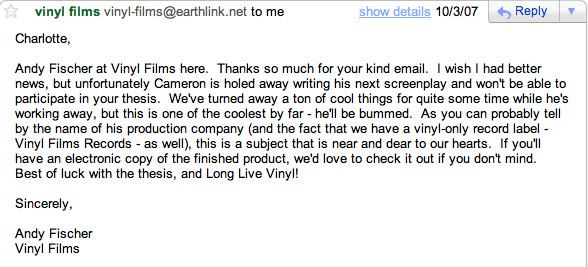
What you don't know about me was that I was so inspired by Crowe's work as a music journalist, that I decided to write about my time as a music journalist as part of my Master's thesis, I contacted him. I told him that I was writing about the death of vinyl music. Below is his response:


While I didn't score an interview with Cameron Crowe, in a future blog, I'll begin sharing some of the interviews I did snag with legendary music critics like Anthony DeCurtis (Rolling Stone), Robert Christgau (Village Voice) and Dave Marsh (CREEM Magazine) to name a few. Reading those magazines turned out to be preparation for writing the biggest project to date--my thesis.